


Alumni’s Talk #4 : Women Entrepreneurs and AI Growth in the MENA Region
In Alumni’s Talk #4, Dr. Amira Meliani shares key findings on women-led entrepreneurship in MENA and why digital inclusion matters now.
Breaking Barriers: Women Entrepreneurs and the Rise of Artificial Intelligence in the MENA Region
Introduction
Women are starting businesses against all odds in the Middle East and North Africa (MENA), where a quiet revolution is taking place. These business owners are changing industries, making jobs, and changing what it means to be a leader in their communities because they are so strong. Still, their road is hard: less than 5% of the region’s start-up capital goes to businesses run by women (World Bank, 2024).
Women business owners in the area not only help the economy, but they also help change society. However, they operate in complex environments shaped by inequitable financial systems, bureaucratic hurdles, and cultural expectations.
My doctoral research examined these dynamics across eight MENA countries—Algeria, Morocco, Tunisia, Egypt, Lebanon, Saudi Arabia, Qatar, and the UAE—through six theoretical frameworks. These include Social Capital Theory (Coleman, 1988), which explores the value of social networks in business resilience; Institutional Theory (Scott, 2014), which examines the impact of formal and informal institutions on entrepreneurship; and Gendered Entrepreneurship Theory (Brush et al., 2009). The study further explored how emerging technologies, particularly Artificial Intelligence (AI), can accelerate empowerment by broadening access to markets, mentorship, and finance.
The findings suggest that digital transformation, when supported by inclusive policy and governance, enables women to move from the margins to the mainstream of economic life. Women’s empowerment, therefore, is both a moral obligation and a macroeconomic necessity for sustainable regional development.
Table1. Global Venture Capital Funding Disparities by Gender, 2023
| Region | Women-Led Startups (%) | Share of VC Funding (%) | Funding Gap (%) |
| North America | 28 | 14 | 14 |
| Europe | 26 | 11 | 15 |
| Asia-Pacific | 22 | 9 | 13 |
| MENA | 17 | 5 | 12 |
Source: OECD (2023); Brush et al. (2023); Meliani (2025).
Figure 1. Comparative Overview of Women Entrepreneurship Across MENA (2023–2024)
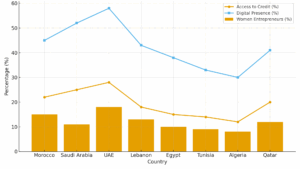
Source: Author’s elaboration based on Meliani (2025); UN Women (2023); OECD (2023); World Bank (2024).
The Research Journey
The driving forces behind embarking on this study are derived from both professional and personal convictions. Having lived and worked in diverse contexts and cultures, I have firsthand experienced the invisible walls that impede women’s empowerment by denying them access to credit, mobility, and even a voice. Consequently, my conviction that women’s economic empowerment is imperative for achieving equality and ensuring a well-functioning economy has remained strengthened (OECD, 2023).
The field study across eight diverse cultures revealed the resilience of women entrepreneurs. Many people expressed how challenging it is to balance business entrepreneurial goals with family and social obligations, validating Welter’s (2011) claim that opportunity is generally and profoundly affected by context.
What impressed me the most was how women were able to come up with new ideas despite the way things were set up. They used digital tools and networks in ways that weren’t typical.
Their examples convey the potency of digital literacy and enabling environments as a hope for better days to come in women’s entrepreneurship in the MENA region. – Meliani, 2025.
Key Findings
1. Persistent Structural Barriers
Institutional and financial barriers remain among the most significant challenges. Women’s limited property ownership restricts access to credit, and bureaucratic inefficiencies discourage formal business registration (World Bank, 2024). Gendered perceptions of financial risk continue to shape investor decisions, particularly in countries like Tunisia and Egypt.
2. Networking and Social Capital
Social capital plays a vital role in business resilience (Coleman, 1988; Brush et al., 2019). Women often rely on informal networks—family, friends, and digital communities—to share knowledge and resources. However, the absence of structured mentorship limits their growth potential. Cross-border mentorship and digital networking initiatives can bridge these gaps (Meliani, 2025).
3. Legal and Cultural Context
While cultural norms remain deeply rooted (ESCWA, 2023), notable reforms are emerging. Morocco and the UAE have pioneered inclusive policies, and Saudi Arabia and Qatar have launched government-backed accelerators for women entrepreneurs. In Morocco, legal simplification between 2020 and 2023 led to a 17% increase in the number of registered women-owned enterprises (OECD, 2023).
Table 2. Women Entrepreneurs in Morocco (2023–2024): Sectoral Distribution and Growth
| Sector | % of Women Entrepreneurs (2023) | % of Women Entrepreneurs (2024) | Growth Rate (2023–2024) |
| Retail & Services | 36 | 38 | +2% |
| Agriculture & Food | 20 | 22 | +2% |
| Handicrafts & Cosmetics | 16 | 18 | +2% |
| Technology & Startups | 9 | 12 | +3% |
| Education & Health | 8 | 10 | +2% |
| Total (All Sectors) | 100 | 100 | +11% overall increase |
Source: Meliani (2025); World Bank (2024); Moroccan Ministry of Industry and Trade (2024).
4. Artificial Intelligence as a Catalyst
AI has become a transformative force for inclusion. In Morocco, AI-based e-commerce platforms empower women’s cooperatives in the argan oil sector to access global markets (Meliani, 2025). In Lebanon and Egypt, AI-driven mentorship and marketing analytics tools provide insights into consumer behavior and market trends, supporting business continuity amid economic crises (UN Women, 2023).
AI-based credit scoring systems are redefining access to finance by assessing performance data instead of collateral—challenging gendered lending norms (World Bank, 2024). This demonstrates how technology can counter bias and promote fairness.
Figure 2. AI and Financial Inclusion for Women Entrepreneurs (2024)
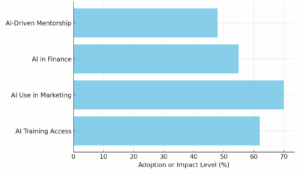
Source: Author’s elaboration based on Meliani (2025); UN Women (2023); World Bank (2024); OECD (2023).
Table 3 – Summary of AI Integration Areas Supporting Women Entrepreneurs (2024)
| AI Application Area | Example Tools / Platforms | Reported Impact |
| Digital Training & Mentorship | AI-based learning (Coursera, Google Women Techmakers) | +65% skills improvement reported |
| E-Commerce & Marketing | Predictive analytics, automated ad targeting | +45% revenue increase for online SMEs |
| Financial Inclusion | AI credit scoring for microfinance (FinTech startups in MENA) | +30% increase in women accessing capital |
| Networking & Support | AI-driven matching and community tools | +50% expansion in professional networks |
Source: Meliani (2025); UN Women (2023); OECD (2023); World Bank (2024).
5. Entry into High-Growth Sectors
Entrepreneurship is transitioning from necessity-driven to innovation-driven, as evidenced by the growing number of women entering FinTech, AI, and sustainable manufacturing (GEM, 2023). The women of MENA can chart a path for diversification and innovation in a region if they are given training.
Implications and Recommendations
Policymakers should make it easier for businesses to register, move the licensing process online, and ensure that lending rules are fair to both men and women. To prevent mistakes, banks and other financial institutions should use AI to assess the risk of an action (World Bank, 2024).
Business leaders can generate new ideas by working with women-run start-ups. Private-public partnerships should focus on programs that teach women to use technology and prepare them to sell their goods in other countries.
Gender lens investing ensures that programs that help women business owners access capital actually work, which is well-suited to development agencies. The integration of Social Capital Theory (Coleman, 1988) and technological empowerment models establishes a strong framework for developing inclusive economic policies (Welter, 2011; Meliani, 2025).
Figure 3. The number of women-owned businesses in Morocco by sector from 2023 to 2024
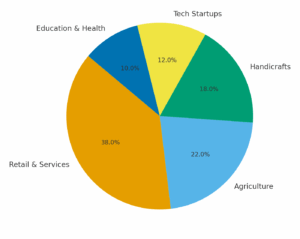
Source: Meliani (2025); World Bank (2024); Moroccan Ministry of Industry and Trade (2024).
Conclusion
The MENA region is on the brink of a significant shift in favor of women entrepreneurs. While challenges have always existed for women in this region due to its culture and infrastructure, innovation and forward-thinking policies are creating opportunities despite these obstacles. The empowerment of women through digital inclusion and education is a key imperative.
The MENA region’s future economic resilience will largely depend on its ability to capitalize on women’s creativity, leadership skills, and new ideas. Consequently, further investigation is necessary to examine the influence of AI and social capital in fostering an inclusive ecosystem where women are not merely participants but pioneers in the digital economy.
About the Author
Dr. Amira Meliani is a DBA graduate from Geneva Business School, specializing in women’s entrepreneurship, digital transformation, and inclusive ec
 onomic development in the MENA region. Her research bridges academic inquiry and applied strategy, advising start-ups and policymakers on gender-inclusive innovation and entrepreneurship