




Alumni’s Talk #7 : How Aviation Fuels Rwanda’s Socio-Economic Transformation
In Alumni’s Talk #7, Dr. Funmilayo Hamilton Carroll shows how aviation is propelling Rwanda’s socio-economic transformation beyond its landlocked limits.
Air-Linked, Not Landlocked: Aviation’s Role in Rwanda’s Socio-Economic Transformation
When you think of Rwanda, aviation might not be the first thing that comes to mind.
As a landlocked country, Rwanda has no direct access to the sea — a disadvantage that often translates into higher trade costs, slower connectivity, and reliance on neighboring states for global market access. But here’s the twist: Rwanda is redefining itself as Air-Linked, using aviation as a powerful tool to overcome its geographic limitations.
The aviation ecosystem is increasingly shaping Rwanda’s socio-economic story. Beyond moving people, it is driving trade, boosting tourism, and opening investment opportunities. Yet challenges remain from limited infrastructure to high operating costs and tough regional competition.
Key questions emerge: How much does the aviation ecosystem really move the needle for Rwanda’s economy? What’s holding it back? And what strategies can unlock its full potential?
For policymakers, business leaders, and investors, the answers matter. The aviation ecosystem isn’t just about airports and airlines; it’s about jobs, connectivity, resilience, capacity building and global competitiveness. And in Rwanda’s case, it might just be the difference between being landlocked and being truly connected to the world.
Aviation’s Impact on Rwanda’s Economy
Aviation has proven to be a key driver of Rwanda’s socio-economic development, particularly through its impact on trade volumes and tourism revenue. Major investments, such as the development of New Bugesera International Airport, are expected to significantly boost Rwanda’s economy by expanding passenger and cargo capacity, thereby positioning the country as a regional aviation hub that enhances trade, tourism, and investment opportunities.
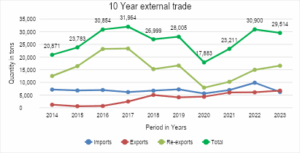
Figure 1. External Trade by Air in Quantity (2014–2023). Source: RAC and RwandAir (2024).
Its completion will not only ease pressure on Kigali International Airport but also act as a catalyst for long-term socio-economic growth in line with Rwanda’s Vision 2050, enabling greater access to global markets and enhancing competitiveness. Aviation not only facilitates the movement of people and goods but also supports Rwanda’s broader economic transformation by connecting the country to international trade and investment flows.
Enablers of Growth
Several enablers underpin this progress. Strategic partnerships—most notably with Qatar Airways—have expanded Rwanda’s aviation reach and brought in valuable expertise. Infrastructure development, supported by significant investment, has enhanced airport capacity and operational efficiency. Compliance with international standards has also provided a foundation of stability, while Rwanda’s innovative performance-based drone regulations position the country as a global pioneer in aviation governance.
Obstacles and Risks
Despite these gains, the sector continues to face critical challenges. Workforce shortages, particularly in pilots, engineers, and technicians, limit operational capacity and force reliance on expatriate staff. Financial exposure and market dependency create vulnerabilities to external shocks and regional competition. Additionally, regulatory hurdles and bureaucratic processes slow down project implementation, while limited data availability undermines evidence-based decision making.
Strategic Recommendations
To unlock the sector’s full potential, several strategic actions are recommended. Rwanda should diversify trade partnerships to reduce dependency on a narrow set of markets and strengthen workforce development through expanded training. Implementing phased infrastructure upgrades will help manage costs while improving efficiency, and streamlining supply chains will enhance product quality and competitiveness. Finally, embedding data-driven decision making and deepening regional cooperation will strengthen resilience and promote sustainable growth.
Broader Relevance
Overall, the findings highlight that Rwanda—and other landlocked developing countries—can transform their geographic disadvantage by becoming air-linked. For policymakers, investors, and business leaders, aviation represents more than connectivity; it is a catalyst for trade, tourism, investment, and human capital development. Harnessed strategically, it can drive sustainable and inclusive economic transformation across Africa
Implications and Recommendations
The findings show that aviation is a pivotal enabler of Rwanda’s socio-economic transformation, offering transferable lessons to other landlocked developing countries. For policymakers, the implication is clear: not having aviation integrated into broader development agendas can have a negative impact on the broader objectives of Rwanda. Rwanda’s investments in airport infrastructure and regulatory reforms demonstrate how aviation can offset geographic disadvantages. At the same time, continued dependence on expatriate expertise and foreign partnerships highlights the urgent need for investments and purposeful actions in local workforce development.
For industry leaders, aligning investment strategies with government priorities, fostering innovation, and adopting data-driven planning are essential. Businesses can draw on these insights to enhance competitiveness and resilience, particularly in supply chains, cargo handling, and tourism services.
Actionable Recommendations:
- Diversify trade and tourism markets to reduce dependency risks.
- Expand technical training and promote local workforce participation.
- Implement phased infrastructure upgrades to manage costs.
- Strengthen regional cooperation to harmonize aviation standards.
- Leverage data-driven decision making for strategic planning.
Together, these steps position aviation as a cornerstone of Rwanda’s economic resilience and sustainable growth
Conclusion
Rwanda’s story shows how aviation can turn the limits of being landlocked into the opportunities of being air-linked. Through strategic investments, strong governance, and forward-thinking policies, the country has boosted trade, tourism, and connectivity. Yet, challenges remain, from workforce shortages to financial vulnerabilities. Still, the lesson is clear: aviation can be a cornerstone of socio-economic growth, not only for Rwanda but for other landlocked developing countries. Future research should explore how digital innovation, sustainability, and regional integration can further strengthen aviation’s role as a driver of inclusive growth and resilience in landlocked developing countries.