




Alumni’s Talk #6 : Retaining tech talent in Africa
In Alumni’s Talk #6, Dr. Gladys Ify Nonyelu explores how strong employer branding helps African tech firms attract and retain the talent driving digital growth.
WINNING AND RETAINING TECHNOLOGY TALENT IN AFRICA: THE POWER OF EMPLOYER BRAND
INTRODUCTION
Sustaining growth in a rapidly evolving global economy requires a strategic focus on human capital – the ultimate source of competitive advantage. Globally, technology-driven economies continually develop strategies to attract and retain top talent. In Africa, the challenge is more acute: despite rapid digital innovation, a young workforce, and investments, the continent faces a significant skills gap.

As of 2024, Africa had approximately 716,000 developers, compared to 6.1 million in Europe and 6.5 million in Asia, underscoring the urgency of talent retention. African technology firms also compete with multinationals offering higher pay, relocation prospects, and global prestige.
My doctoral research examined preferences for African or non-African employers and key factors influencing talents’ decisions on employers. The findings revealed a strong preference for non-African employers and that, beyond compensation, belonging, purpose, and organisational culture are equally critical. Thus, cultivating human-centred “employer branding” is essential for sustaining Africa’s technology growth.
THE RESEARCH JOURNEY
My research was inspired by firsthand observation of a critical challenge: the disconnect between the rapid growth of Africa’s technology sector and struggles to attract and retain top talent. The core issue lies in balancing innovation with a strategic focus on building “employer brands” that reflect the values and aspirations of technology professionals.
This inquiry led to exploring employer branding – not as a corporate buzzword, but as a strategic business advantage – to answer the question: employer preferences and what attracts and retains top technology talent? – through interviews/focus group discussions with 80 technology professionals, primarily in the fintech sector across Nigeria, Kenya and the UK, using the Theory of Planned Behaviour (TPB) as a guiding framework. TPB explains individuals’ choices through three key determinants:
- Attitudes – personal evaluation of a behaviour: e.g., working here will be worthwhile
- Subjective norms – perceived social expectations
- Perceived behavioural control – belief in one’s ability to succeed
This approach enabled a holistic analysis of both rational factors (e.g., pay – benefits) and psychological influences. The journey revealed the realities of “brain drain” and inspiring stories of professionals committed to Africa’s digital future and its untapped potential of creating an environment where talents can thrive.
KEY FINDINGS
The findings revealed several compelling insights, highlighting both the risks and opportunities:
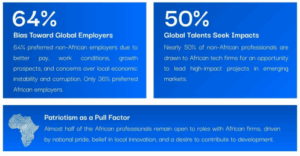
- The belonging factor
- One of the most significant findings was the role of belonging in career decision-making b. Professionals who chose African firms emphasised the importance of community, connection, and shared purpose
- An environment where leaders listen, teams are inclusive, and cultures celebrate collective identity
A snapshot of key findings
- Beyond pay: culture and leadership matter
- While compensation attracts talent, retention is strongly informed by culture
- Experienced professionals valued transparent leadership, clear career growth pathways, and a sense of purpose more than perks
- A mismatch between employer branding and actual employee experience eroded trust and negatively impacted retention
- The gender gap persists
Although gender was not a central focus, over 80% of participants were male, underscoring the ongoing gender imbalance in the global technology space is mirrored in Africa. Addressing this gap is essential for building truly inclusive employer brands
- What talent really wants:
Twelve employer brand attributes emerged as key elements influencing talent’s choice of employers: A culture of belonging, global exposure, diversity and inclusion, transparent leadership, competitive pay, career growth, work-life balance, continuous learning, recognition, technological infrastructure, organisational reputation, and employee voice.

The 12 attributes for winning and keeping talent.
Ultimately, these findings reveal that employer choices are far from transactional – they are deeply shaped by whether professionals feel empowered, valued, and connected to a meaningful mission.
IMPLICATIONS AND RECOMMENDATIONS
For African technology leaders, HR professionals, and policymakers, the research offers several practical takeaways. While these elements are relevant to organisations worldwide, they are particularly urgent for African firms:
- Lead with culture, not just pay
Competitive compensation is essential but not sufficient. Technology firms must invest in leadership development, inclusive communication systems, and authentic organisational cultures that align with employees’ personal values and sense of purpose.
- Design for belonging
Develop initiatives that foster inclusivity and human connection – such as regular manager – employee authentic connection, recognition programs, community-impact projects, and mentorship structures to nurture a genuine sense of belonging.
- Think “glocal”
Employer branding strategies should balance global best practices with local cultural, social, and economic realities. A “glocal” approach ensures relevance within African contexts while maintaining global competitiveness.
- Invest in growth pathways
Provide a clear career progression map, access to global project exposure, and continuous learning opportunities. Such investment signals long-term commitment to employee development and strengthens retention.
- Address the gender gap
Proactive diversity and inclusion initiatives are critical. By creating pathways for women in technology, firms can expand their talent pools, enhance innovation, and reinforce their employer brand.
Ultimately, winning the war for talent in Africa cannot be achieved by replicating imported strategies without adaptation. It requires contextually relevant, human-centered employer branding that inspires talent to engage, grow, and help shape the continent’s future.
CONCLUSION

The African technology sector stands at a critical juncture, balancing rapid innovation with fierce competition for talent. Its future depends not on funding alone but on the ability to attract, engage, and retain top professionals. My research shows that the true differentiator is culture – an authentic employer brand rooted in belonging, purpose, and growth. Winning talents requires an empathetic employer brand, global strategies adapted to local realities, and mission-focused workplaces where African tech talent can thrive. Building on these insights, I have developed a coaching framework for leaders and a community to continue the conversation and further research.